
Social media may seem like a lawless land when it comes to connecting with coworkers. There are really no right or wrong choices; choosing who to connect with, when, and on what platform is a highly personal decision and there’s a lot to consider.
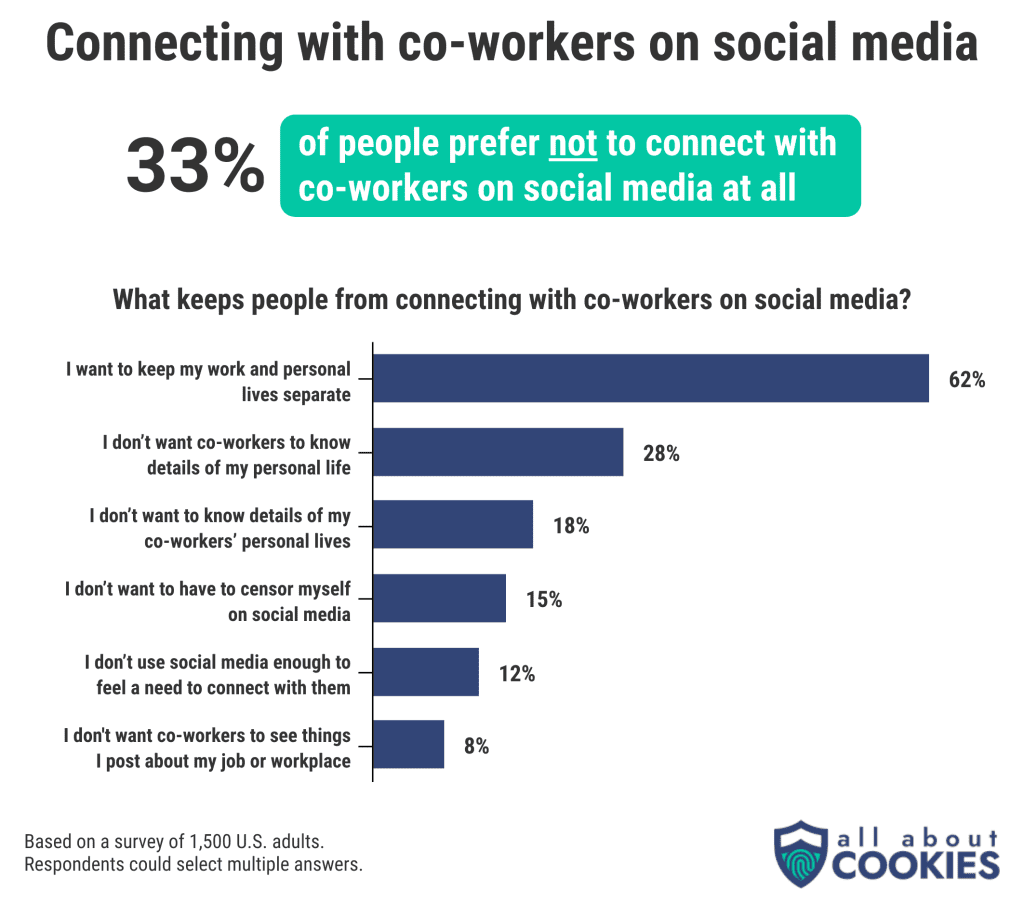
Research from All About Cookies shows one out of three people prefer not to connect with coworkers on social media, and only 9% commit strictly to not connecting with coworkers. Setting your own boundaries in the form of a personal social media policy can help draw the line when it comes to connecting with coworkers.
Come Up with a Personal Social Media Policy
We’re more connected than ever, which does wonders for relationship-building, but it may complicate relationships with coworkers and superiors. Perhaps the best approach is to have a personal policy of how you’re willing to connect or interact with coworkers on social media, though it’s strongly recommended to never friend or follow your boss or your subordinate(s).
Some options are:
- Block everyone you work with.
- Don’t block anyone, but don’t be friends or follow anyone. Check your privacy settings if taking this route.
- Create professional-only profiles or only connect on LinkedIn.
- Friend and follow freely.
- Don’t be friends or follow current coworkers; fair game if you no longer work together.
No matter how you choose to handle coworkers and social media, be sure to consider any guidelines outlined by your company to avoid mishaps.
Factors to Consider When Making Your Personal Policy
- Fairness. Consider if you want to treat all coworkers the same. If you choose to connect with some but not all who want to connect with you, how will you handle conversations if this is brought up?
- The risks. Workplace friendships are increasingly important according to research, but how much is too much for your coworkers to know about you? If you like to share divisive opinions, extremely personal information, or things your coworkers may be offended by, perhaps a personal policy of not connecting with coworkers is in order.
- Depending on your line of work, this rule may still offend people; in some industries, it’s common or expected to connect with coworkers on social media. If you opt out, it may create interpersonal challenges.
- Your digital footprint. Almost everyone has a digital footprint, and early adapters of social media may have decades of personal information on their accounts. The more access coworkers have to your personal social media, the more potential there is for people with ill intentions to construct narratives that could harm your reputation. This is especially important if you’re a long-time social media user and haven’t done a thorough clean-up of your accounts.
- Boundaries. Opening your social media profiles to your coworkers limits your ability to control how much of your life you share with them. Maybe you want to post online about a relative who passed away or details of a health issue you’re facing—your coworkers may not need access to those details.
- Work-life balance. It’s a boundary between professional and personal life. You’re still the same person, but you may want to have some separation between the two and from the people you spend your workweek with. It may not be healthy for you to spend your workdays with someone, then go home and see them on your social media.
How to Respond When a Coworker or Your Boss Connects with You
If a coworker or your boss follows you on social media, that’s when your personal policy comes into play. You can allow the connection, quietly decline it, or remove them as a follower if you’re already connected. If you’re more comfortable connecting only on LinkedIn, you can extend an invitation to connect there instead.
You’re never stuck if you change your mind about your personal social media policy. If you’ve already accepted some coworkers as friends or followers, you can stay connected or quietly remove them from your list. If you’re close in person or frequently interact online, it may be a good idea to mention to them that you’re cleaning up your account, but there are no hard feelings.
Ultimately, how you engage with coworkers on social media is a personal decision that should align with your professional boundaries. By considering your own needs and company guidelines, you can create a personal social media policy that works best for you.
About Express Employment International
Express Employment International supports the Express Employment Professionals franchise and affiliated brands, including Specialized Recruiting Group and Express Healthcare Staffing. The Express franchise brand is an industry-leading, international staffing company with franchise locations in the U.S., Canada, South Africa, Australia, and New Zealand.

Last Updated on March 12, 2026
